

Much in Every Way
What a praying mother actually gives you — a Mother’s Day reflection from Romans 3

I get this question more often than you might think.
A mother slips up to me after a service, eyes a little tired, voice a little lower than usual, and she says some version of this: “Pastor, my child grew up in this church. He sat in these pews. She went to AWANA. They went on the youth retreats. And they’re still rebellious. Still lost. So what was the point of all of it?”
It’s an honest question. And, as it turns out, it is not a new question.
The apostle Paul fielded a version of it almost two thousand years ago. His version came from Jewish believers in Rome who had just heard him argue — with the relentless logic he is famous for — that being a son of Abraham did not, by itself, save anyone. The covenant, the circumcision, the altars, the sacrifices, the centuries of being God’s chosen people — none of it, on its own, made a Jew right with God any more than a baptism or a parent-child dedication makes a child a Christian today.
You can almost hear the pushback rising in the room:
Then what was it all for?
Paul anticipates the question and writes it down himself:
“Then what advantage has the Jew? Or what is the value of circumcision?” (Romans 3:1)
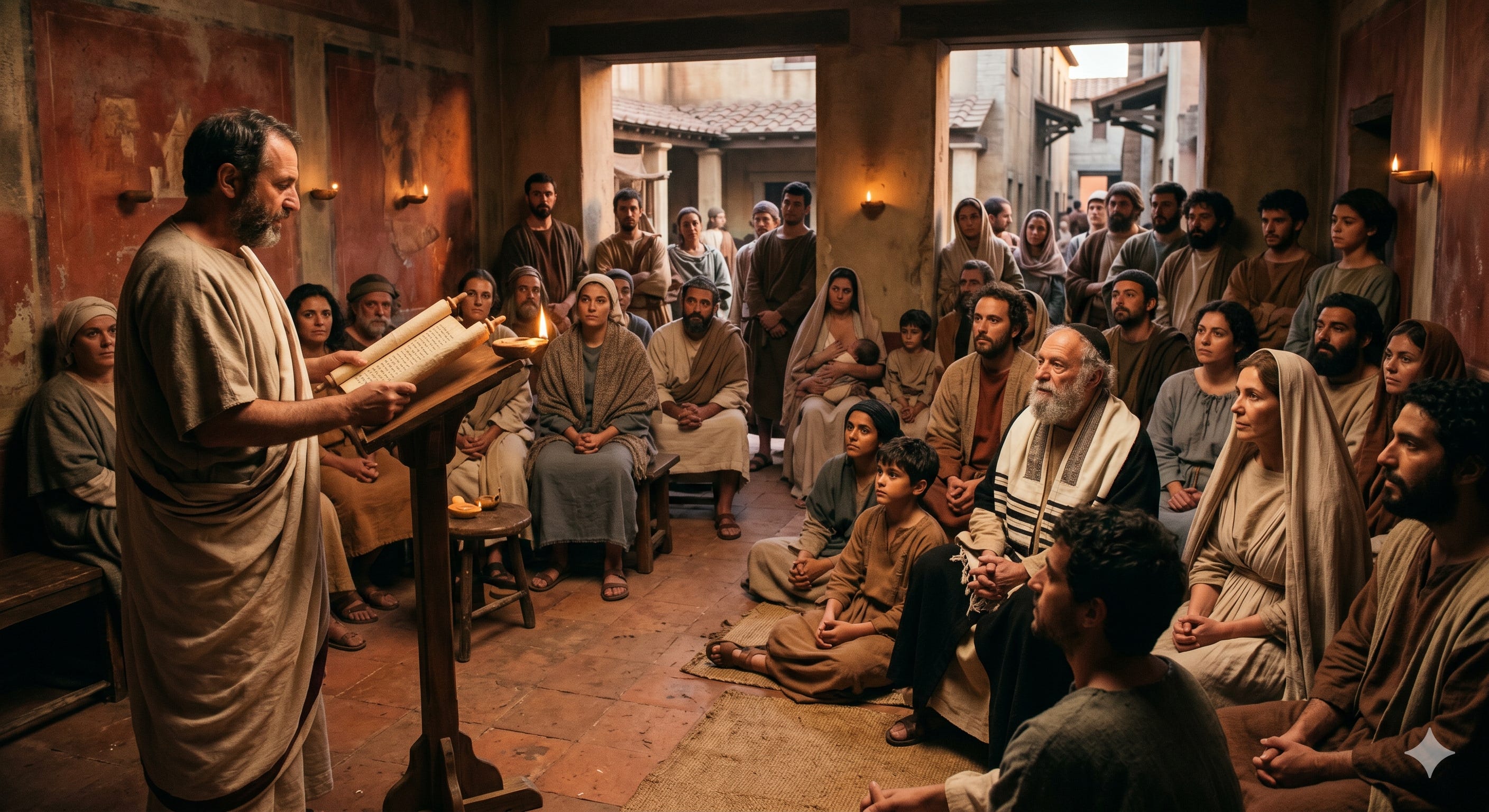
If you’ve been following Paul’s argument, you might expect him to say, “None whatsoever.” That would fit the trajectory. That would be the punchline.
But that’s not what he says.
“Much in every way. To begin with, the Jews were entrusted with the oracles of God.” (Romans 3:2)
Much in every way. Not “a little.” Not “in some respects.” Not “perhaps under certain conditions.” Whatever you can think of, multiply it. The advantage is more than you can count.
And I want to tell you, with as much pastoral seriousness as I can muster, that the same primary advantage Paul gives to ethnic Israel in the Old Testament has been given to every boy and girl raised by a Christian mother in the New.
— — —
A Word About False Binaries
Before we get to the advantage, let me clear away a piece of theological underbrush.
Some Jews in Paul’s day believed that the very act of being circumcised had saved them. The Latin theologians later gave this idea a name — ex opere operato, “by the work performed.” The notion is that a religious rite, simply by being performed, automatically conveys grace.
It doesn’t. As Paul puts it just a few verses earlier, “circumcision indeed is of value if you obey the law, but if you break the law, your circumcision becomes uncircumcision” (Romans 2:25).
The same is true at every level of Christian practice:
• The fact that an infant has been sprinkled does not save him.
• The fact that a child has gone through parent-child dedication does not save her.
• The fact that an adult has been immersed does not save him.
• The fact that your daughter walked the aisle at six years old does not, by itself, save her.
There is no transmissible grace in an ordinance. Your child will have to grow up and choose Christ for herself. You cannot smuggle her into the kingdom by putting her through enough religious hoops.
But — and this is the point Paul refuses to let us miss — to say that something does not automatically save is not the same as saying it offers no advantage. That’s a false binary. Paul says these things do not save, and in the same breath he says the advantage is much in every way.
So what is the advantage?
— — —
Entrusted
“To begin with, the Jews were entrusted with the oracles of God.” (Romans 3:2)
Two things here demand our attention: the object — the oracles of God — and the action — entrusted with.
Start with the object. The phrase “oracles of God” appears only four times in the New Testament. Each time it means the same thing: a divine utterance. A divine revelation. The very speech of God Himself.
Warren Buffett earned the nickname “the Oracle of Omaha” because he speaks with an authority the market listens to. An oracle, in the ancient sense, is a word from a higher source. Now imagine that source is not a famous investor but the God who flung the stars into space, who set the planets spinning, who knows the number of hairs on your head — and He has spoken. And His speech has been preserved for us in a book.
The Bible you read to your children is not a book of stories. It is not a book of moral lessons with Jesus pasted onto the end. It is the very speech of the living God. When you open the cover, God speaks. When you turn the page, He speaks again.
“All Scripture is breathed out by God and profitable for teaching, for reproof, for correction, and for training in righteousness.” (2 Timothy 3:16)
There is no higher privilege a human being can enjoy than to be spoken to by God.
We get excited about much less. I had lunch once with the First Lady of Florida; the menu is framed in my kitchen. My wife and I once dined with the President and First Lady of Guatemala, and we work that into as many conversations as we can. You don’t think of us as ordinary rednecks, do you?
Now multiply that by infinity. That’s what it is to have the Word of God in your home.
Think about Paul’s logic for a moment. When he is asked what advantage there was in being a Jew, he has a thousand things he could have said. He could have answered, “Much in every way! To begin with, they walked through the Red Sea on dry ground.” He could have pointed to manna in the wilderness, or the walls of Jericho, or the slaying of giants, or the fire that fell on Mount Carmel.
He doesn’t.
He reaches past every miracle, past every wonder, past every wall that fell, past every parted sea — and he lays his hand on the scrolls. The greatest privilege of being a Jew was not that they were a delivered people. It was that they were a spoken-to people. They had the Word.
— — —
The Famine We Don’t Talk About
If the greatest privilege a human being can have is to be spoken to by God, then the greatest tragedy a human being can suffer is for God to stop speaking.
Listen to Amos:
“Behold, the days are coming,” declares the Lord God, “when I will send a famine on the land — not a famine of bread, nor a thirst for water, but of hearing the words of the Lord. They shall wander from sea to sea, and from north to east; they shall run to and fro, to seek the word of the Lord, but they shall not find it.” (Amos 8:11–12)
A famine of bread is terrible. A drought of water is worse. But a famine of the Word of God is the most desolate condition any soul can know. To be left to ourselves. To be cut off from the speaking God. To have heaven shut up and silent over the roof of your house.
Mothers, hear me carefully: do not raise your children in a scriptural famine. Do not let your home be one in which the Word of God is rarely heard. There are families in our churches today where the children know every song on the radio, every line from every show, every athlete’s stat line — and could not tell you what the Bible says about the most basic question of human existence. That is a famine. And in many cases it is a famine the parents themselves curated.
— — —
The Second Word — Entrusted
Now look at Paul’s verb. He doesn’t merely say the Jews had the oracles of God. He says they were entrustedwith them.
To be entrusted means something has been placed in your care that does not, strictly speaking, belong to you. You’re a steward. A custodian. A guardian.
If a friend hands you the key to her house while she’s out of town, you are entrusted. If a bank gives you the combination to a safe deposit box, you are entrusted. If a hospital nurse hands a newborn to a mother, she is entrusted.
When God places a child in your arms, He places more than a child. He places a soul. A soul made in His image. A soul that will outlast every star you see at night. A soul that needs, more than anything else on earth, to hear what God has said.
And this is why, when Solomon writes about how a child learns wisdom, he does not name only the father:
“Hear, my son, your father’s instruction, and forsake not your mother’s teaching.” (Proverbs 1:8)
In the holy economy of the home, the mother is a theologian. The mother is a Bible scholar. The mother is the first preacher most of us ever heard.
— — —
Lois, Eunice, and a Boy Named Timothy
If you want to see what this looks like with skin on, look at a boy named Timothy.
When Paul writes to Timothy, the young pastor he has entrusted with the church at Ephesus, he says this:
“I am reminded of your sincere faith, a faith that dwelt first in your grandmother Lois and your mother Eunice and now, I am sure, dwells in you as well.” (2 Timothy 1:5)
And then a chapter later:
“But as for you, continue in what you have learned and have firmly believed, knowing from whom you learned it and how from childhood you have been acquainted with the sacred writings, which are able to make you wise for salvation through faith in Christ Jesus.” (2 Timothy 3:14–15)
Did you catch that? The reason Paul could trust Timothy with one of the most strategic churches in the empire — the reason Timothy could lead, the reason Timothy could endure suffering for the gospel — was because somewhere in a humble home in Lystra, a mother named Eunice and a grandmother named Lois had spent years pouring the Word of God into a little boy’s ears.
They didn’t have a Bible app. They didn’t have a children’s storybook Bible with cartoon Jonahs and friendly whales. They had the scrolls. And they had a little boy whose ears they whispered them into.
From the cradle, that boy heard the Word of God.
What advantage is there in that?
Much in every way.
— — —
So How Does a Mother Do This?
I’ll be brief and practical, because Paul is, and because mothers — in my pastoral experience — would rather have one usable thing than ten poetic ones.
1. Get into the Word yourself, and let your children catch you doing it. A mother who has a worn Bible is preaching a louder sermon than she knows.
2. Use the Word for both reproof and encouragement. Don’t let it be the book that only comes out when someone is in trouble. Reach for it when you’re proud of them, too.
3. Submit to it personally. Children can smell hypocrisy from a long way off. They can also smell the real thing.
4. Celebrate it. We don’t have to do this. We get to do this. Let the Word be good news in your home, not a chore.
5. Let it be the center of conversation. Questions, answers, what-do-you-think-this-means, what-would-you-have-done. Make the Bible a place where the family thinks together.
You may feel as though you haven’t given your children what other parents have given. Maybe you couldn’t afford the private school. Maybe you couldn’t take them to Disney every summer. Maybe the car you handed them at sixteen wasn’t the one they wanted.
But if you put the Word of God into their souls, you have given them an inheritance moths and rust cannot destroy, and that thieves cannot break in and steal.
— — —
Three Charges for Mother’s Day
It is possible, by the way, to be in church all the time and still miss Jesus. You’ll remember that Mary and Joseph once lost the boy Jesus in the middle of a religious festival. So many people do exactly that — they spend a lifetime adjacent to the things of God and never come face to face with the God of those things.
So this Mother’s Day, three charges:
If you have a mother who gave you the Word, thank God for her — and tell her so, today, while you still can. Don’t assume she knows. Say it out loud.
If you are a praying mother, take heart. You may not see the fruit yet. You may be watching a prodigal walk farther into the far country than you ever imagined he would go. Hear this:
“So shall my word be that goes out from my mouth; it shall not return to me empty, but it shall accomplish that which I purpose, and shall succeed in the thing for which I sent it.” (Isaiah 55:11)
The Word you sowed is not lost. God is not finished.
And if you have never trusted Christ yourself, take the step the oracles of God are calling you to make. Confess that you are a sinner. Repent of your self-reliance. Place your faith in Jesus Christ alone. Not in your mother’s faith. Not in your church attendance. Not in your baptism. In Christ.
What advantage is there in being raised in a Christian home? What profit is there in having a praying mother? What good came of all those nights at the kitchen table reading from a children’s Bible, of those bedside prayers you assumed had been long since forgotten?
Much in every way.
You have been entrusted with the oracles of God.
— — —
Pastor Zach serves First Baptist Church of Fernandina Beach. This essay is adapted from a Sunday sermon on Romans 2:25–3:4.